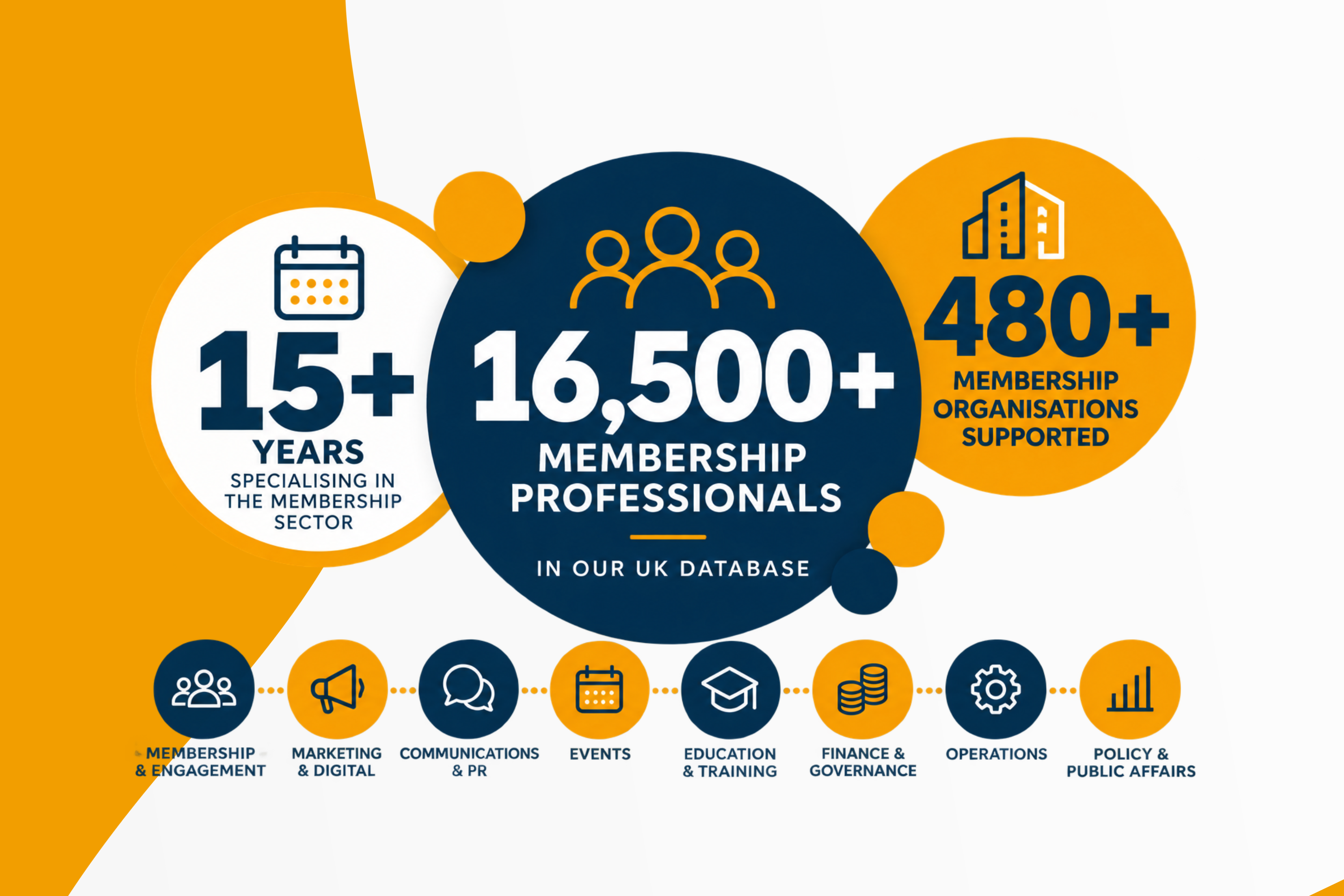
16,500+ talented people. One very specialist network.
There is a slightly strange thing about recruitment statistics. A UK database of more than 16,500 professionals sounds impressive. More than 15 years specialising in the membership sector sounds reassuring too. But what can they specifically mean for you?
There is a slightly strange thing about recruitment statistics.
A UK database of more than 16,500 professionals sounds impressive. More than 15 years specialising in the membership sector sounds reassuring too.
But if you are sitting there with a resignation in your inbox, a new role you need to create, a team that is already stretched or a vacancy that has attracted 200 applications without producing the person you actually want to hire, those numbers only matter if they make your recruitment better.
So rather than simply telling you how big our network is or how long we have been doing this, we thought it would be more interesting to explain what 16,500+ people and 15+ years spent immersed in membership-sector talent actually gives you.
And, perhaps more importantly, why it should matter when you next recruit.
16,500+ doesn't mean 16,500 CVs
This is probably the most important distinction.
A recruitment database can become a fairly meaningless number if it simply represents everyone who has ever uploaded a CV, applied for a job or spoken to a recruiter. For us, the interesting part is the history behind the number.
Our UK network has been built over more than 15 years of recruiting specifically across membership organisations, trade associations, professional bodies, regulatory bodies, commercial membership organisations, private members' clubs and other membership-focused organisations.
It spans the disciplines that make those organisations work, from Membership & Engagement, Policy & Public Affairs and Marketing & Digital through to Events, Finance & Governance, Operations, Communications & PR, Education & Training and senior leadership.
That means when a brief lands with us, we aren't necessarily starting with a blank search box and asking:
Who is looking for a job today?We can ask a much more useful question:
Who do we already know who could be right for this?
There is a big difference.
The best person for your organisation may not have applied for anything this week. They may not have updated their LinkedIn profile or be actively searching job boards. They may be perfectly happy where they are, but open to the right conversation.
They may also have a job title that means you would never find them using the obvious search terms.
A database becomes genuinely valuable when it is more than a list of names; when there is knowledge, history and understanding behind it, and when you know enough about the people within it to make connections that aren't immediately obvious from a keyword search.
15+ years gives you something technology can't create overnight
Recruitment technology is becoming incredibly sophisticated, and we use technology and data extensively ourselves.
But there is something that is much harder to accelerate artificially: pattern recognition.
After more than 15 years focused on one sector, you start recognising the difference between what a job description says and what an organisation might actually need.
-
You know that a Membership Manager in one organisation can be doing a completely different job from a Membership Manager somewhere else.
-
You understand why somebody brilliant in a professional body may or may not translate into a commercially driven trade association.
-
You know that “stakeholder management” might mean supporting thousands of individual professional members in one organisation, while somewhere else it means developing relationships with CEOs and senior leaders from member companies.
-
You also begin to understand when membership-sector experience genuinely matters and, equally importantly, when insisting on it might unnecessarily rule out somebody exceptional.
-
And increasingly, you recognise when an organisation could be recruiting for the job it used to have, rather than the capabilities it is going to need next.
That last point matters enormously.
Membership roles are changing. AI, data, digital capability, commercial thinking, member insight, new income streams and changing expectations are increasingly influencing jobs that might have looked very different even a few years ago.
Fifteen-plus years of specialism doesn't mean assuming that what worked 15 years ago still works today.
Quite the opposite. It gives you enough context to recognise what is changing, and more candidates aren't necessarily the answer!
This feels particularly relevant in today's recruitment market.
It is perfectly possible to advertise a vacancy and receive a very large number of applications.
But 150 applications don't necessarily give you 150 realistic options; sometimes, they just give you a very long Tuesday afternoon!
The real recruitment challenge isn't always generating more volume; increasingly, it is identifying the small number of people within a much bigger market who genuinely have the skills, experience, motivations and potential to succeed in your particular organisation.
This is where a specialist database becomes very different from a large audience.
If we already know that somebody understands corporate membership, has successfully managed renewals, has led a CRM implementation, can talk commercially about member value and might consider the right opportunity, that knowledge is considerably more useful than simply knowing that 600 people clicked ‘apply’.
Reach matters. Relevance matters more.
What does 16,500+ mean if you've never used Membership Bespoke?
Perhaps you've always recruited directly.
Maybe you've been successful doing it and have never really had a reason to speak to us.
And we certainly wouldn't suggest that every vacancy needs a recruiter. It doesn't. But there are moments when access to a specialist network can change the shape of a search considerably.
-
Perhaps you've advertised and the right person hasn't appeared.
-
Perhaps the skills you need are unusually specific, you're replacing somebody excellent and the benchmark is high, or the role itself has changed and you're not completely sure what the market now looks like.
-
Or perhaps you simply want to know whether there are people outside your immediate reach who could make you reconsider what “good” looks like.
That is when those 16,500+ people become relevant.
Not because we're going to send you hundreds of CVs , please don't worry, we won't, but because we can start by looking within a UK network that has been built specifically around the membership sector.
In other words, your search doesn't necessarily begin on the day you brief us. In many ways, we have been building towards it for more than 15 years.
And what if you've worked with us for years?
This is where those numbers take on a slightly different meaning. One of the advantages of a long-term recruitment relationship isn't simply that your recruiter recognises your organisation's name when you call. Over time, we learn the nuances.
-
The person who flourished in your organisation.
-
The technically excellent candidate who probably wouldn't have.
-
The pace your team operates at.
The personalities and working styles that tend to succeed.
-
How commercial a particular role really needs to be.
-
Whether somebody needs to influence a board, engage corporate members, understand governance, bring fresh digital thinking or simply be the sort of person who can walk into a small team and get stuck in.
That knowledge compounds.
And because our candidate network is evolving at the same time, the relationship isn't static either. The candidate who was too junior for you three years ago may now be exactly the person you need. Someone we spoke to about one type of role may have developed an entirely new skill set. A candidate who wasn't quite right for one vacancy might be exceptional for another.
That's one of the quieter advantages of working with a specialist recruiter over time:
-
We remember the market while learning your organisation.
-
16,500 people create something else: market intelligence.
-
The value of a specialist database isn't limited to filling vacancies.
-
Thousands of conversations with people working across membership give us a continually evolving picture of the market: what people are being paid, what makes them move, which skills are becoming more valuable, where candidate expectations are changing and which roles are becoming increasingly difficult to recruit.
Combine that with more than 15 years of conversations with membership organisations themselves and another layer of insight starts to emerge.
-
You notice when organisations begin asking for data skills in roles that previously wouldn't have required them.
-
You see commercial capability moving higher up the agenda.
-
You hear more conversations about AI confidence, digital transformation and alternative income streams.
-
You notice job titles changing and previously separate disciplines beginning to overlap.
-
And because we're talking to candidates as well as employers, we see the market from both directions.
That means sometimes the most useful thing we can tell a client isn't:
“Here are five CVs.”
It's:
“The person you've described exists, but here's what you'll need to do to attract them.”
Or perhaps:
“We think you could be looking for the wrong thing.”
The database isn’t really the product
Perhaps that is the slightly unexpected conclusion to all of this, because while we’re incredibly proud to have built a UK network of more than 16,500 professionals, and equally proud of the 15+ years we’ve spent specialising in the membership sector, neither number on its own is the reason to use Membership Bespoke.
The real value comes from what happens when you connect those two things: knowing the organisations and the people within the sector, understanding the different disciplines and how they overlap, seeing how skills and roles are changing, remembering the people who have impressed us over the years and knowing who might be open to the right opportunity, even when they aren’t actively looking for a new role.
It is also about understanding what motivates talented people to move and, just as importantly, what makes them want to stay once they get there, while recognising when previous membership experience is genuinely essential and when bringing in expertise from somewhere else could give an organisation exactly the fresh thinking or specialist capability it needs.
When all of that knowledge comes together, the aim is to turn a very large potential talent pool into a small, relevant shortlist of people who make a hiring manager think, “Yes. That’s what we were looking for.”
Because ultimately, our job isn’t to give you access to the biggest possible pile of CVs; it is to use everything we know about the market, the sector, your organisation and the people within our network to make that pile considerably smaller, considerably more relevant and, most importantly, considerably better.
Never worked with Membership Bespoke before?
If you’re considering a hire, even if the role isn’t live yet, it can be worth talking to us before everything has been decided, because we can give you a sense of the talent we’re seeing, the skills becoming more valuable, what candidates are looking for and what you could realistically expect to attract.
You don’t need to arrive with a finished job description or even be completely certain what the role should look like, because sometimes the most useful conversation happens much earlier, when there is still an opportunity to shape the brief around what the market can offer and what your organisation genuinely needs.
And if you’ve worked with us many times before, thank you.
Every brief, placement and conversation over those 15+ years has added to our understanding of the membership sector, the organisations within it and, most importantly, the people who make it work.
Whether it is your first conversation with Membership Bespoke or you’ve been working with us for years, the principle remains exactly the same: we’re not here to find you more people. We’re here to help you find the right one.